
Health · WeCollate
Less time on paperwork. More time with patients.
Every hospital writes its own cancer treatment protocols, apart. WeCollate builds a shared template from the documents hospitals already hold, shows who has approved what, and flags every change. Each hospital keeps control of its own library and its own approvals.
The cost today
Senior staff time goes into rewriting what others have already written.
- to write and approve one full SACT protocol: 6 to draft, 6 for three approvers.
- 12 hours
- to write and approve one full SACT protocol: 6 to draft, 6 for three approvers.
- a year just to re-check about 550 protocols every two years in one hospital.
- ~3,300 hours
- a year just to re-check about 550 protocols every two years in one hospital.
- of senior staff time a year, before a single new protocol is written.
- About 2 WTE
- of senior staff time a year, before a single new protocol is written.
- of published SACT protocols are late for review, or will be within a year.
- 63%
- of published SACT protocols are late for review, or will be within a year.
What it does
One clear way to build a protocol. Most of the work is done before you start.
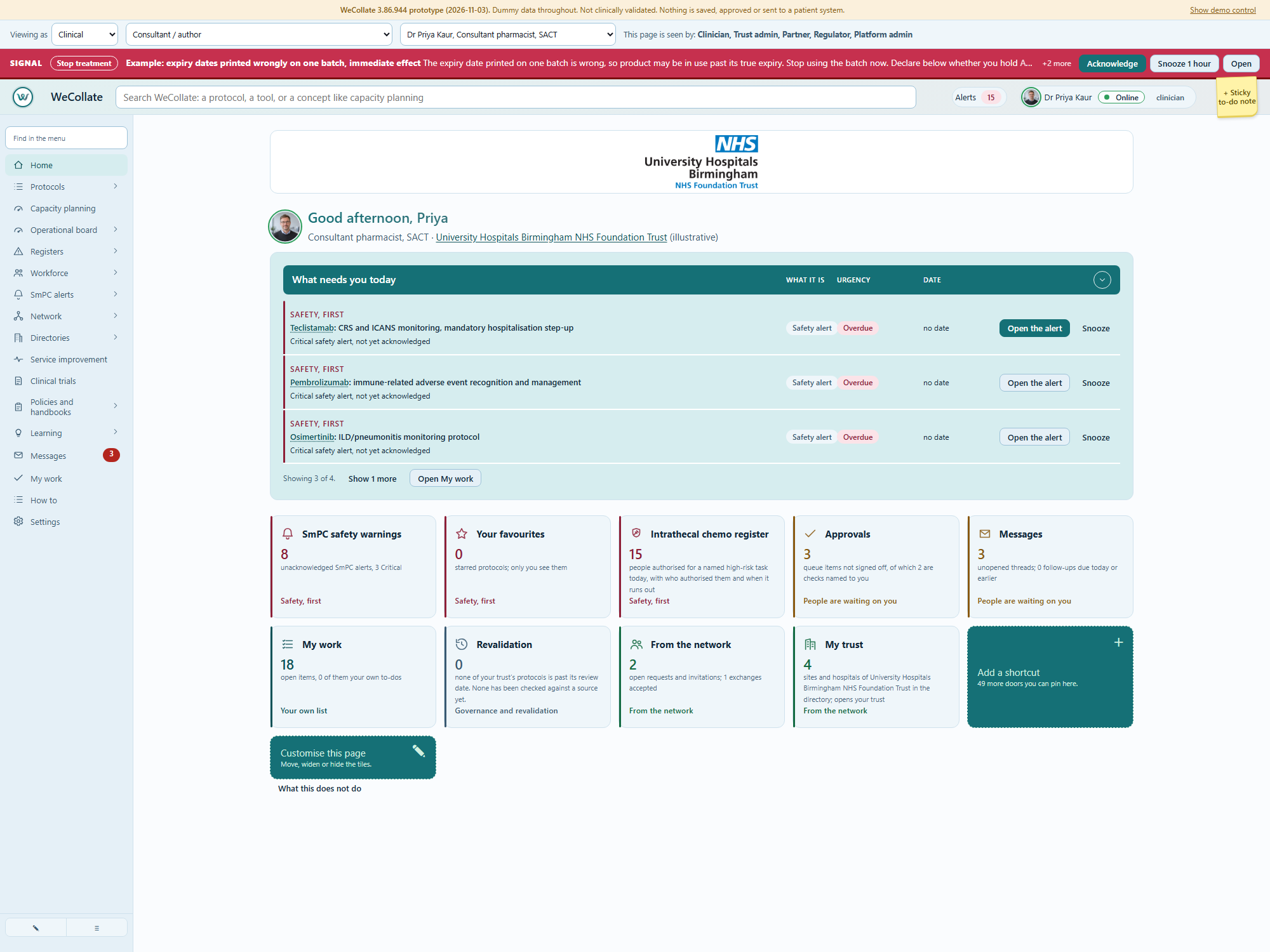
WeCollate starts with SACT protocols, the documents that set out each cancer drug treatment, and applies the same method to policies, handbooks and guidelines.
Start with a ready template
Built from protocols hospitals already use, with the evidence attached. Nobody starts from a blank page.
See who else uses it
How many hospitals have approved it, and when.
Compare side by side
See where hospitals differ. Pick one, or combine them.
Add what is yours
The services you can deliver locally sit on top of the shared template.
Approve it your way
Your own approval process. Your name, your version.
Kept up to date
A live document, not a PDF that goes out of date.
Changes arrive automatically
Safety alerts and drug information changes are flagged, large or small, with a deadline and a named owner.
Review dates count down
A named person is told before a protocol goes out of date, instead of a date passing unnoticed on page one.
One search, always current
Every library in one place. E-prescribing systems link to the live version, not a saved file.
The benefits
Safer protocols, less duplicated work, and no licence fee.
The strongest case for WeCollate is better clinical governance combined with less repeated specialist work across hospitals. The working prototype makes that credible; a staged rollout makes it measurable.
Patient safety
Better visibility of outdated protocols, evidence changes and outstanding clinical approvals.
Specialist capacity
Less duplicated protocol development and review, with measurable time released to clinical services.
NHS affordability
No software licence charges to trusts, subject to validating the independent funding model.
Implementation credibility
A working prototype, documented technical gaps and a phased route to a clinically assured service.
Scalable NHS benefit
Begin in one trust, expand across the West Midlands and potentially support national adoption.
Clinical value and patient safety
A direct response to a recognised NHS problem
Protocols are developed and maintained separately in every hospital, duplicating specialist effort and creating inconsistent governance. WeCollate gives hospitals a practical way to share that work.
Faster access to new cancer treatments
Shared, evidence-linked templates could shorten the time between a treatment becoming available and local approval. This is modelled in the business case; clinical evidence is still required.
Safety information linked to the protocols it affects
Medicine updates, safety alerts and evidence are connected to the relevant protocols, with a named person responsible for reviewing each change.
Clinical accountability stays with each hospital
Hospitals keep control of their protocols, local amendments and approvals. Shared content supports decisions without transferring responsibility.
Measurable improvement in protocol governance
Overdue reviews, missing review dates and gaps against the 27-part SACT checklist give a baseline for measuring completeness, currency and traceability.
Financial and operational value
Specialist clinical capacity released
At full UK adoption the business case models around 33,000 specialist working days a year, equivalent to about £12m of capacity. This is an illustrative national scenario, not a verified cash saving.
Less duplicated work across organisations
Clinicians start from an existing evidence-linked template and concentrate on local requirements, instead of every hospital researching and drafting the same protocol.
Free access for NHS organisations
No recurring software licence fee for participating trusts. Onboarding, clinical governance and operational costs still apply.
A funding model outside NHS budgets
Pharmaceutical companies would fund an independently governed information service through fixed annual fees, provided demand, fair-market-value pricing and editorial independence are established.
Identifiable cost and benefit drivers
Protocol volumes, review effort, staffing, onboarding and running costs can all be measured, so funders can test the value rather than rely on broad efficiency claims.
Technology and implementation
A substantial working prototype already exists
Protocol discovery, comparison, authoring, evidence tracking and local approval workflows are already built. Funding develops a working concept, not a new idea.
Designed to expand
The proposed production service is componentised and multi-tenant, so more hospitals and services can join without rebuilding the core platform.
An incremental rollout limits exposure
Start with one NHS trust, then expand under control. Each stage has defined decisions and assurance before further investment is released.
Strategic value and scale
Built for collaborative Cancer Alliance working
Hospitals share clinical knowledge while keeping local governance. A West Midlands deployment could become a repeatable model for other Cancer Alliances.
Applications beyond cancer protocols
The same capabilities can support clinical policies, guidelines, safety registers and other controlled documents, without funding those modules in the first release.
Some of these strengths are already shown in the prototype; others are benefits that production deployment and independent evaluation must still prove, with clinical safety, affordability and sustainable operation established before wider rollout.
Time and money saved
Estimate what your establishment could get back.
Based on 12 senior hours per protocol review and a 1,650-hour working year. Set the share of that work a shared template removes, and add your own hourly cost to see the value.
The deck’s example is about 550 for one hospital.
Each protocol re-checked every this many years.
Starts at 50%. Starting from a ready, already-approved template instead of a blank page.
Starts at £36 an hour. Replace it with your own fully loaded figure for consultants, pharmacists and nurses.
Senior time spent on reviews today
3,300 hours a year
275 reviews × 12 hours each
Time handed back to patient care
1,650 hours
About 1.0 WTE of senior staff a year
Value of that time
£59,400 a year
Plus no licence fee: WeCollate is free for healthcare.
Free for healthcare. Always.
No licence fee, ever. Start small: share the protocols you already have, and we report back on where they match and where they differ.
Get in touch
Start the conversation
Tell us about your enterprise challenges and we'll show you how EPF can help.